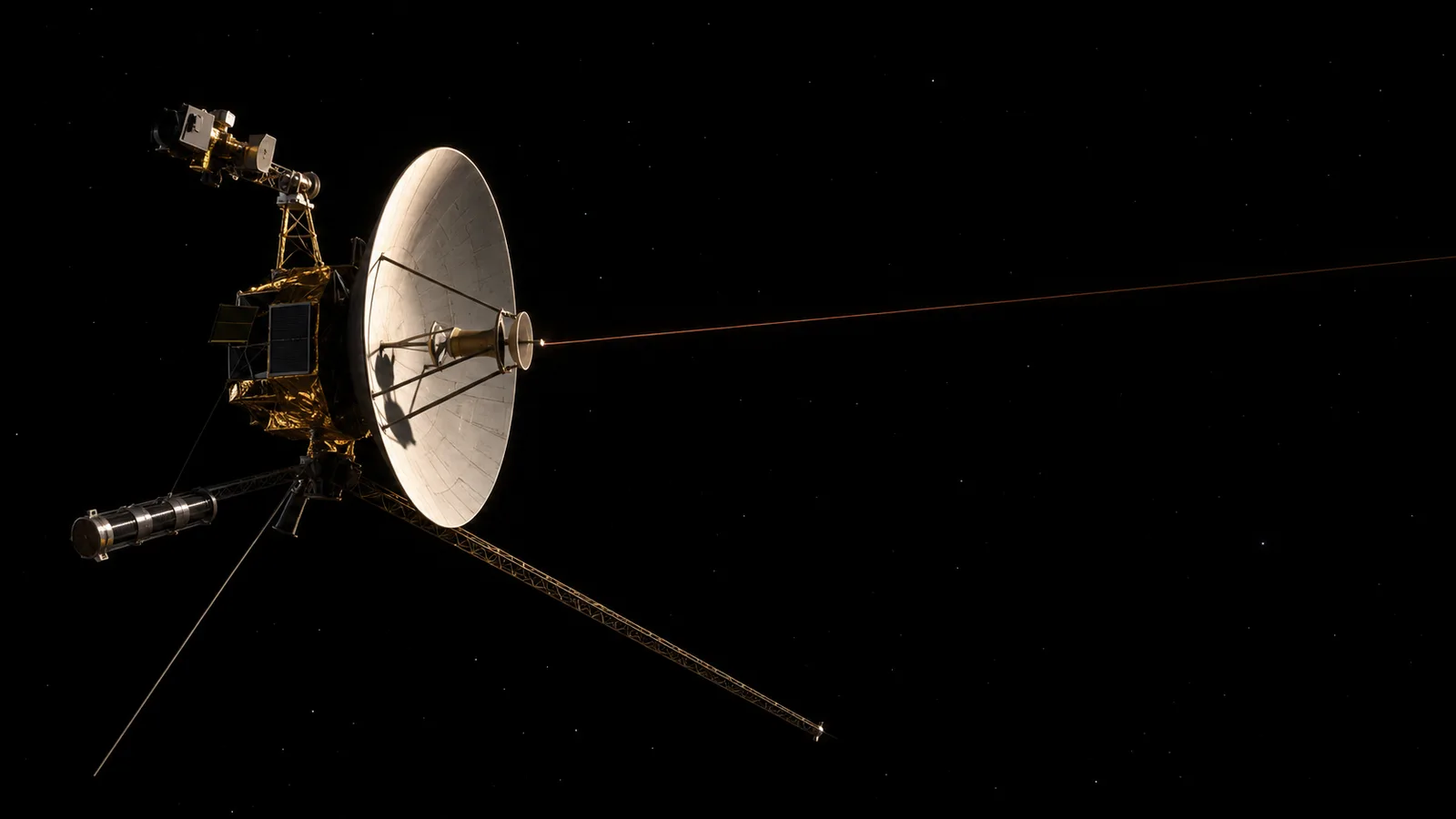
NASA's Voyager 1 spacecraft reached one light-day from Earth early on a Wednesday morning, after more than 49 years of constant travel. It crossed the one light-day threshold at 2:16 a.m. Pacific Time, or 5:16 a.m. Eastern, on Nov. 18, 2026. Voyager 1 became the first spacecraft to reach that distance.
What one light-day means
A light-day is the distance light travels in 24 hours, approximately 16 billion miles, or about 25.9 billion kilometers. Voyager 1 is now one light-day from Earth, so signals take a full 24 hours to reach the probe. A radio signal traveling at the speed of light needs 24 hours to get there, and its return signal needs another 24 hours to reach Earth.
A long journey
Voyager 1 is the most distant human-made object in the cosmos. It continues moving farther into interstellar space at roughly 38,000 miles per hour. Voyager 1 is expected to continue its journey for years to come. Voyager 1 and Voyager 2 were launched in 1977, and the Voyager mission turns 50 in the upcoming year.
Interstellar milestones
On Aug. 25, 2012, Voyager 1 became the first manmade object to cross into interstellar space, passing beyond the heliosphere. Voyager 2 followed it into interstellar space in November 2018.
Power constraints
Both Voyager spacecraft are still transmitting data from interstellar space. NASA has shut off some science instruments over the years to save battery life, but both probes are still operating. Voyager 1's power supply is gradually weakening, losing about four watts each year.