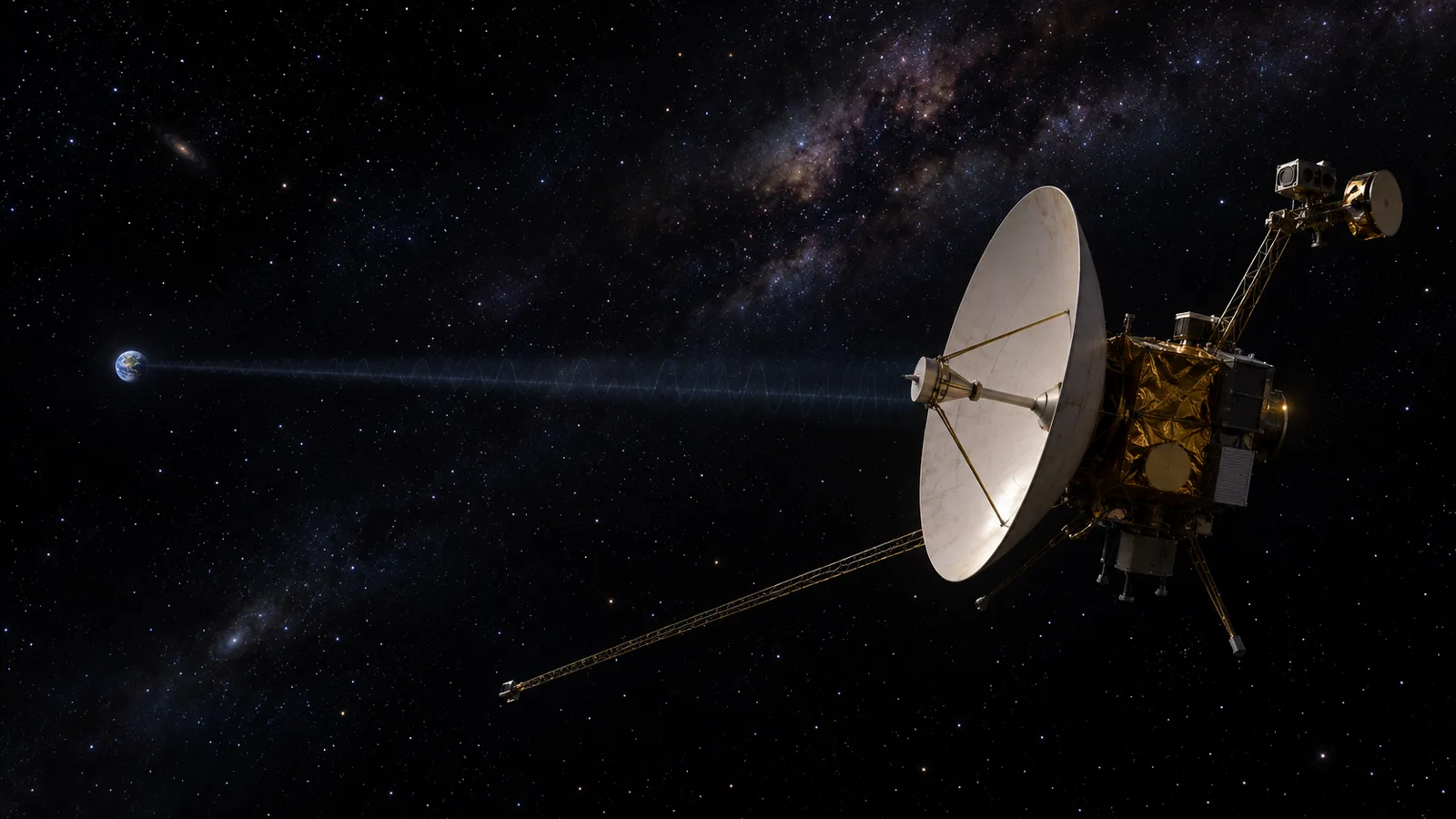
Voyager 1 will reach one light-day from Earth on Nov. 18, 2026. According to a NASA statement quoted in the article, it will be the first human-made object to reach that distance from Earth. One light-day is the distance light travels in a day, about 16 billion miles (26 billion kilometers). Put another way, it is the distance a photon can travel in one full Earth day, or 24 hours. When Voyager 1 gets there, its radio signals will take precisely 24 hours at the speed of light to reach Earth.
NASA invited people to celebrate with an event called "Shine Bright for Voyager's Light-Day," held after sunset on Tuesday, Nov. 17, the day before the milestone. NASA urged people to create a wave of golden light, using Morse code to spell V-G-R, Voyager's call sign, into the night sky. Participants are encouraged to flash the three-letter call sign in Morse code, according to a NASA statement.
Voyager 1 is the farthest human-made object from Earth after almost 50 years in space. It is more than 16 billion miles away and was launched 49 years before the article was published. It has been moving away from Earth at 61,100 kilometers (38,000 miles) per hour. Commands sent by the Voyager team take a full 24 hours to reach it.
Voyager 1 and Voyager 2 were launched in 1977. Voyager 1's original mission was to fly past Jupiter and Saturn, and it completed those goals in 1979 and 1980 respectively. It reached what NASA defines as interstellar space, the expansive region between star systems, in 2012. Both spacecraft each carry a gold-plated copper disc known as the Golden Record.
Voyager 2 visited Jupiter, Saturn, Uranus and Neptune, and entered interstellar space in 2018. It is not expected to reach the one light-day mark until 2035. Two instruments remain operating on Voyager 1: the magnetometer and the plasma wave subsystem. NASA hopes Voyager 1 will keep communicating with Earth into the early 2030s, before its power supply drops below the minimum needed to run anything.