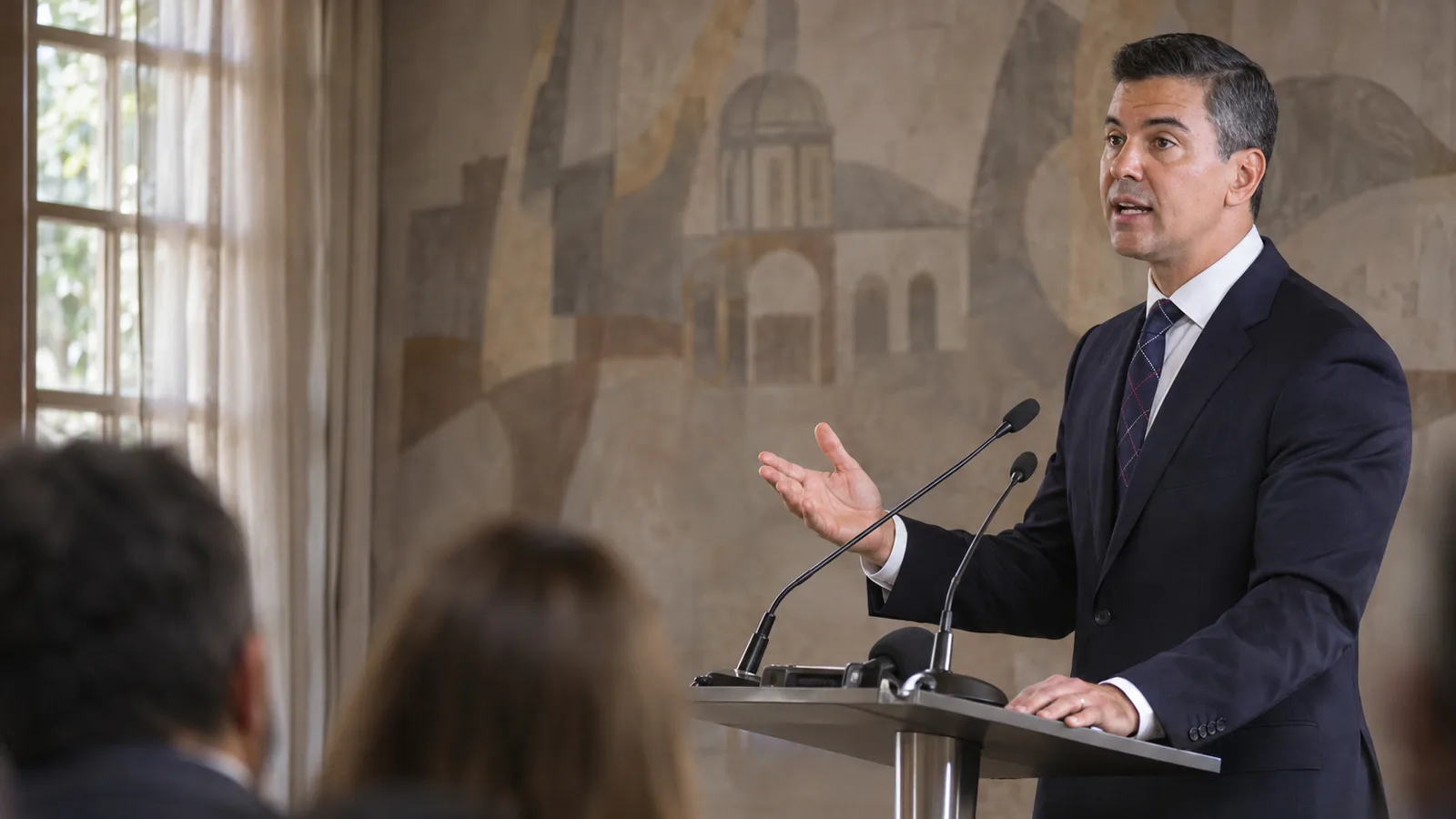
Paraguay's president, Santiago Peña, resigned on Thursday after a crisis that collapsed the country's banking system. The central bank had seized Ueno Bank, a major digital lender. The lower house voted 78-0 to impeach him, and prosecutors have charged 27 bank officials and associates.
Paraguay's president, Santiago Peña, resigned on Thursday after a political and financial crisis collapsed the country's banking system in recent days. The lower house voted 78-0 to impeach Peña, and the Senate opened impeachment proceedings, summoning him to appear on Friday. About an hour after Peña's announcement, the lower house unanimously approved the impeachment motion, which now goes to the senate. Colorado Party leader and former president Horacio Cartes posted a statement indicating the party supported the impeachment.
The seizure of Ueno Bank
Paraguay's central bank seized Ueno Bank, a major digital lender, on Tuesday. The bank had fallen below the legal solvency ratio, and once its books were corrected, its capital was less than half the legal minimum. Customers were left unable to access their money after the shutdown. Ueno claimed more than 60% of Paraguay's adults as customers, and an estimated 60% of the adult population banks with it. The central bank voted to transfer Ueno's remaining funds to other financial institutions as part of a resolution.
What regulators found
In June, central bank inspectors found a pattern of risky lending to insiders at Ueno, according to ABC Color. Regulators also found poorly documented lending to companies linked to Ueno's owners, as well as expenses the bank had wrongly counted as assets, according to the central bank.
Public deposits and conflict-of-interest questions
Ueno came to manage between $800m and $850m in deposits from state and pension entities, prompting criticism over conflicts of interest because of Peña's previous shareholding ties to Ueno Holding. As of last month, Ueno reported holding roughly $800 million in public deposits, about a quarter of its total. Peña had a stake in Ueno's holding company until last year. Peña has insisted he committed no wrongdoing, and said he had disposed of all his shares in the group.
Central bank leadership
Peña appointed Carlos Carvallo, president of Financiera Ueno, Ueno Bank's predecessor, to run the central bank. Carvallo later resigned at Peña's request, and Pedro Acosta Bernal was named interim central bank president. The central bank had come under scrutiny for not properly regulating Ueno.
Investigations and charges
Attorney General Emiliano Rolón Fernández ordered three criminal investigations into the crisis, including allegations involving Peña and other current and former government officials. Peña has said he will cooperate with investigators. Prosecutors charged 27 bank officials and associates with breach of trust and attempted fraud. A judge ordered six Ueno executives, including founder Miguel Vázquez and bank President Juan Manuel Gustale, jailed pending trial. Authorities detained eight senior Ueno executives in total.