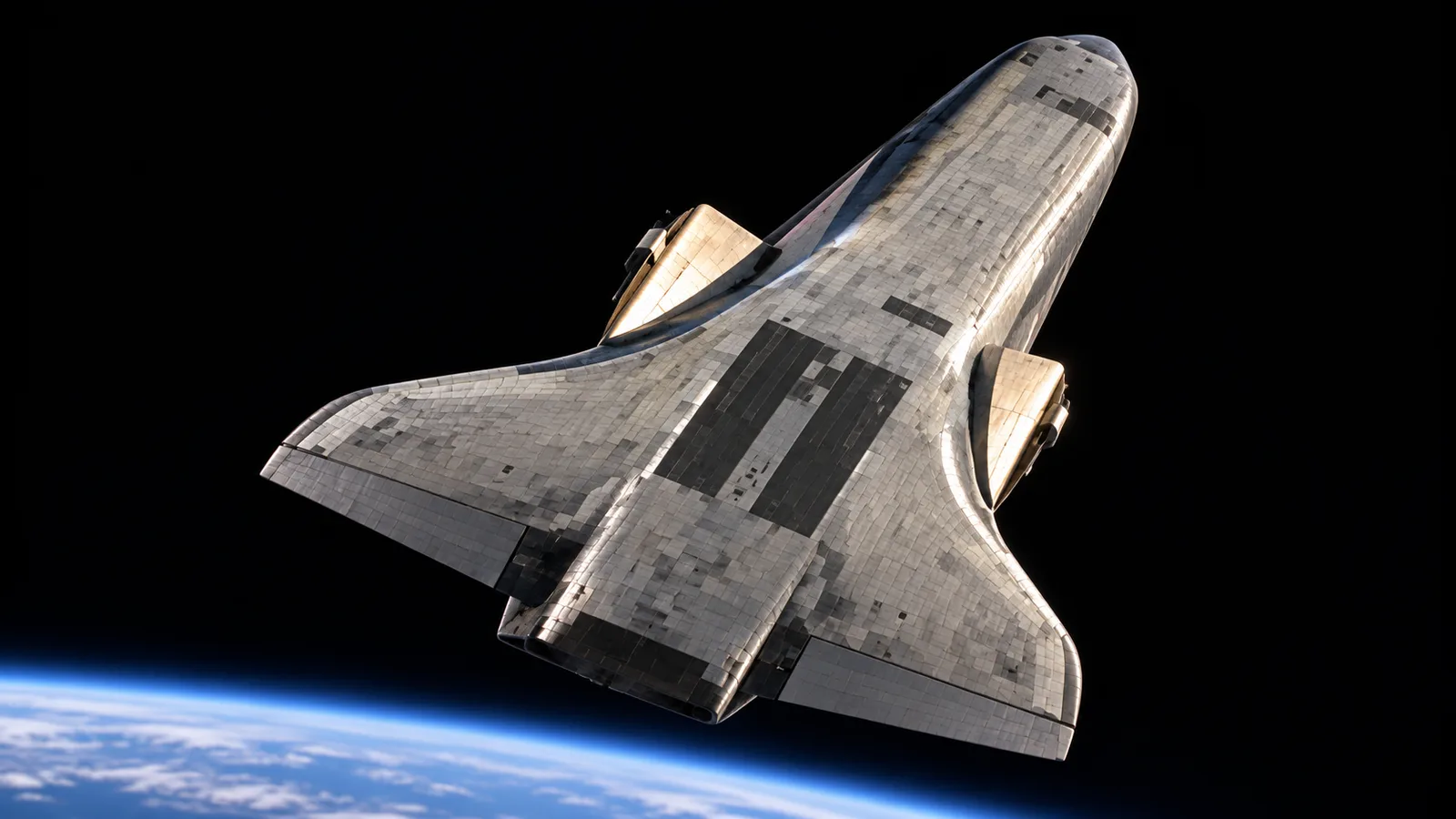
The US Defense Intelligence Agency released a high-resolution photo of China's Shenlong space plane in a new space security report. The agency also estimates China could have operational orbital laser weapons before the end of this decade.
The US Defense Intelligence Agency published a new edition of its report Challenges to Security in Space on 26 October. The document included a high-resolution photograph of China's reusable space plane Shenlong, described as the first such public release. The DIA is the Pentagon's military intelligence service. A surveillance satellite took the first sharp image of the secret craft in 2024, and the Pentagon has now made it public.
How the photo was taken
The picture was captured in 2024 by a commercial imaging satellite owned by Vantor, formerly known as Maxar. The satellite works for the Pentagon and US intelligence agencies, and it captured the Chinese spacecraft during one of its orbits. The image was taken from a distance of about 90 kilometers at a resolution of 4.5 centimeters per pixel. It stayed unpublished until it appeared on page 53 of the DIA document, where the caption calls it a People's Republic of China space plane. Journalist Andrew Jones helped make it go viral on X.
What the image shows
The photo shows a delta-wing design quite similar to the US military X-37B. It shows deployed solar panels on the tail, visible cargo doors, delta wings and the characteristic black heat shield. The spaceplane's design is described as largely a copy of the X-37B. Chinese state press describes the vehicle only as a reusable experimental spacecraft.
China had never published anything about the craft, and it has not released official photographs of the Shenlong. Only blurry photos taken by astronomers from Earth were previously known. In 2024, Colonel John Patrick, then head of US Space Forces in South Korea, showed a low-resolution image of the vehicle at a conference. The Space Force and Maxar declined to comment when The War Zone asked.
A record of four missions
The Shenlong has carried out four missions since 2020, lasting up to nine months. The first flight, in September 2020, lasted about two days. A mission begun in August 2022 lasted about 276 days, and a flight launched in December 2023 lasted about 268 days. The fourth mission began on 7 February 2026, launched on a Long March 2F rocket from the Jiuquan space center, and the craft is currently in orbit.
Subsatellites and proximity operations
Astrophysicist Jonathan McDowell says the Shenlong more recently launched subsatellites over several months, alternating between releasing and recapturing them. His analysis of open-source orbital tracking data indicates a subsatellite was released in June and recovered in July, with the operation repeated in August and September. According to the DIA, during its second flight the craft approached within one kilometer of an accompanying satellite and at some point may have come within 100 meters. The US claims rest on the craft appearing with its cargo bay doors open and presumably interacting with another satellite. Neither the objects released nor the docked satellite demonstrates by itself that China has carried out offensive activities.
Laser weapons assessment
According to the DIA, China already has multiple ground-based laser systems of varying power designed to disrupt, degrade or damage satellites in low Earth orbit. By the late 2020s, the agency says, China could deploy space-based directed-energy systems and more powerful ground-based ones capable of threatening satellites in higher orbits. The agency estimates China could have operational orbital laser weapons before the end of this decade.
Directed-energy weapons are considered ideal anti-satellite systems because they can cause both reversible and irreversible effects. Directed-energy attacks from one satellite to another can also be difficult to attribute. Air Force Secretary Troy Meink acknowledged last month that the US has space control weapons in orbit. He revealed that the Pentagon has deployed weapons in space, making the US the first nation to acknowledge possessing orbital weapons.