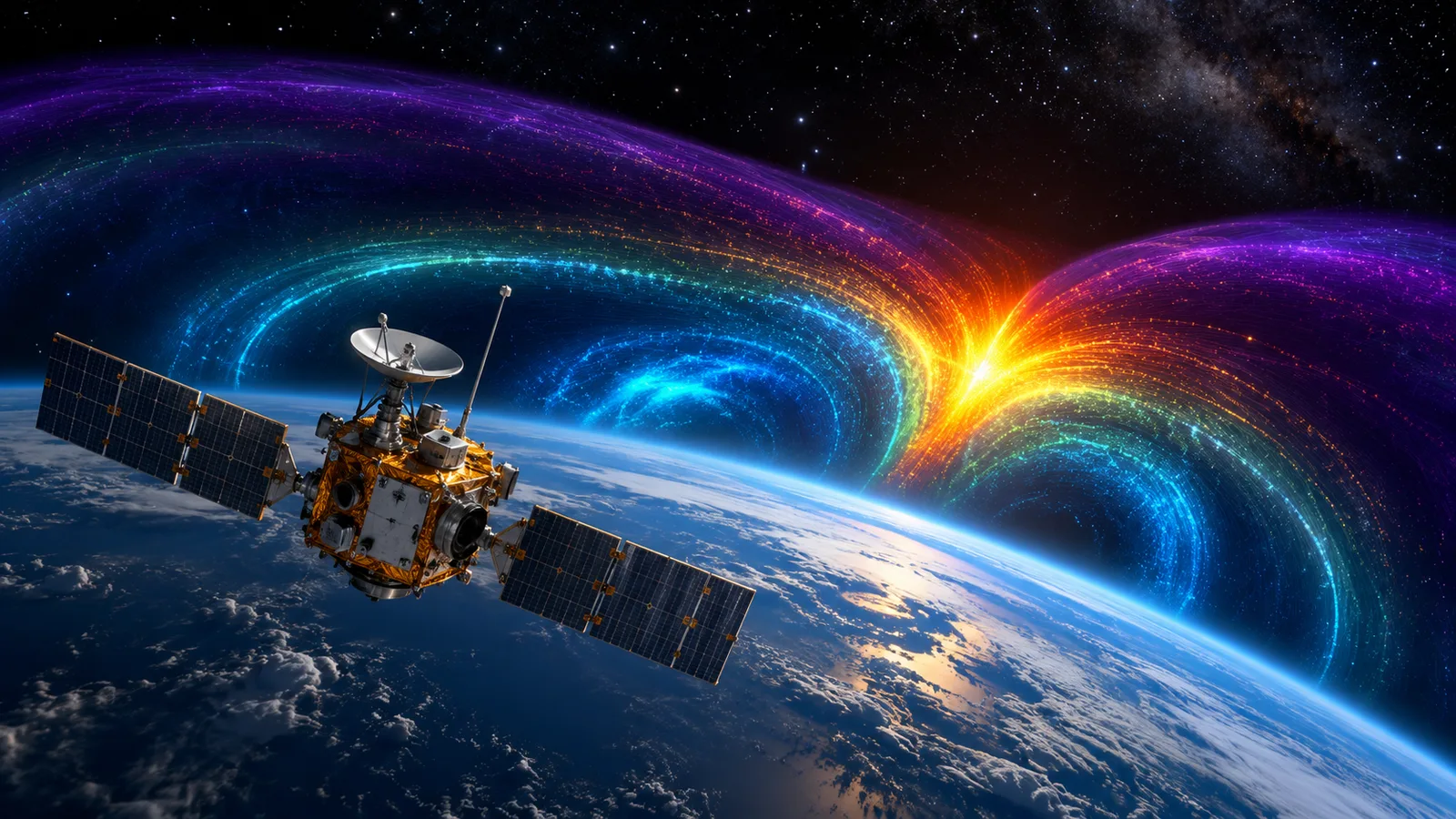
Japan's Arase satellite recorded electrons accelerated to megaelectronvolt energies inside Earth's inner radiation belt during a G5 geomagnetic storm in May 2024. A study led by Yoshizumi Miyoshi of Nagoya University, published in Geophysical Research Letters, points to local acceleration by chorus waves.
During a powerful geomagnetic storm in May 2024, Japan's Arase satellite recorded electrons accelerated to megaelectronvolt energies inside Earth's inner radiation belt. The region had been thought to be an impenetrable barrier to ultra-relativistic electrons. Observations during and after the solar superstorm revealed a sudden flux of high-energy charged particles inside the barrier, some moving at the speed of light with enough energy to breach satellite shields.
The barrier and its discovery
In 2014, NASA's Van Allen Probes observations revealed a sharp boundary about three Earth radii from the planet's center, beyond which the most energetic electrons rarely ventured. The barrier lies at the inner edge of the second Van Allen belt, at roughly 3 Earth radii from Earth's center. Arase detected high-energy particles within this invisible barrier in 2024.
What Arase measured
During the storm's recovery phase, Arase detected a dramatic increase in ultra-relativistic electrons inside the barrier. At about 3 megaelectronvolts, electron flux rose by more than 5,000 times compared with pre-storm levels. As the storm peaked, Arase counted ultra-relativistic electrons at levels 5,000 times higher than the typical background. The new high-energy radiation spread both toward and away from Earth and lasted for months.
Evidence for local acceleration
Researchers at Nagoya University published a study in Geophysical Research Letters explaining that the particles did not enter from an outer radiation belt but were accelerated locally. The study was led by space physicist Yoshizumi Miyoshi of Nagoya University. Electron phase space density measured by Arase showed a distinct peak where the barrier used to be, which is evidence of local acceleration rather than inward transport. Lower-energy electrons increased first, higher-energy electrons followed about half a day later, and electrons above 3 megaelectronvolts surged roughly a day after the initial increase. This staggered progression suggests the electrons were gaining energy locally rather than being swept inward.
The role of the plasmasphere and chorus waves
The superstorm eroded the plasmasphere, a layer of cool, electrically charged particles. The plasmasphere's outer boundary retreated unusually close to Earth, leaving the region around the barrier less densely populated with plasma. The G5-level storm significantly reduced cold plasma, creating a sparse environment in which chorus waves could thrive. The authors say these waves may have accelerated electrons inside the previous boundary. Arase detected intense chorus waves, which can transfer energy to electrons when their oscillations match the electrons' spiraling motion around magnetic field lines.
Aftermath and significance
After the storm, Arase recorded a gradual decline in ultrarelativistic electron levels for several months. It continued to observe the declining levels until October 2024, when another solar storm occurred. Miyoshi, a professor at Nagoya University's Institute for Space-Earth Environmental Research, said understanding energetic electron behavior under extreme space weather is important for assessing radiation risks to spacecraft and improving space weather predictions.