A study by National Cheng Kung University researchers found that the Artemis II launch on April 1, 2026 produced two ionospheric holes stretching about 3,100 miles. The disturbances could have caused brief, localized GPS errors of several meters, but no widespread GPS outage was reported.
A new study found that the Artemis II launch left temporary holes in Earth's upper atmosphere, known as the ionosphere. Researchers at National Cheng Kung University in Taiwan found that the flight and its later engine burns disturbed the ionosphere. The study was published as a pre-print in Geophysical Research Letters.
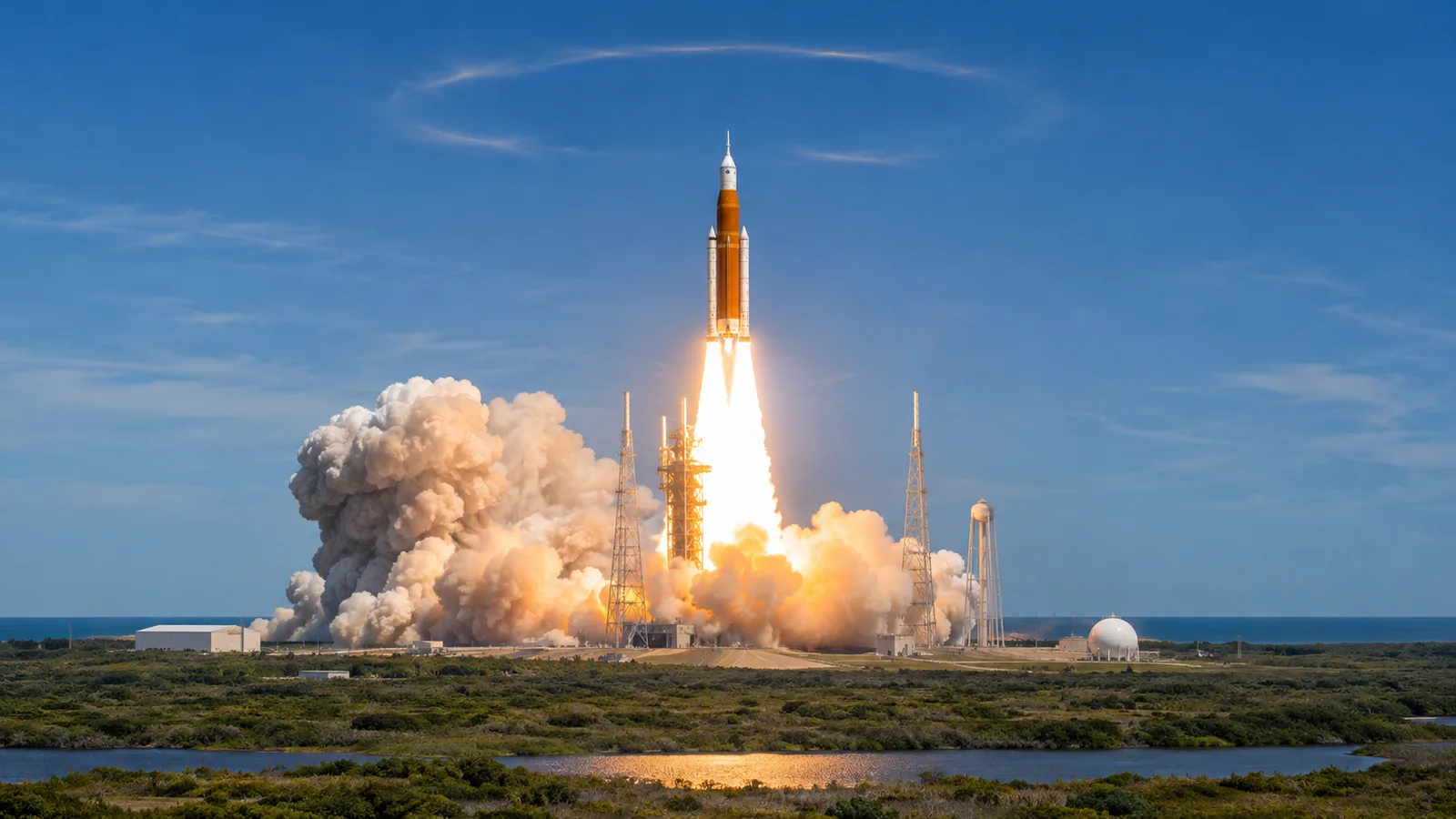
NASA launched Artemis II on April 1, 2026, sending a crew of four astronauts on a path around the Moon for the first time in over fifty years. During the launch, NASA's SLS rocket produced two major disturbances in the ionosphere.
An ionospheric hole is a region of reduced free-electron density, not a physical opening in the atmosphere, and it is distinct from ozone depletion. Artemis II did not physically punch a hole in the atmosphere; its exhaust caused a temporary drop in the concentration of charged particles in part of the ionosphere.
Researchers used data from high-precision ground-based GPS receiver networks to examine ionospheric changes after the launch. They measured how long GPS signals take to travel from space to ground stations, which let them reconstruct how the SLS rocket's passage changed free electron concentrations. Researchers observed two holes: one left by the SLS core stage and another caused by two subsequent burns of the upper stage. Both stretched about 3,100 miles (5,000 kilometers) across the American continent from east to west.
The second disturbance was associated with two upper-stage engine burns at an altitude of approximately 115 miles (185 kilometers), more than an hour after liftoff. It was the more prominent of the two, far more so than the core stage disturbance. The burns left the stronger mark because they took place directly inside the ionosphere. The burns allowed Orion to leave Earth's gravity for the Moon.
The disturbances were stronger than those from any other rocket launch so far. They were up to ten times more intense than those observed after SpaceX Starship test launches. That was the case even though Starship has roughly twice the liftoff thrust of the SLS.
The researchers found that the disturbances were large enough that they could have triggered temporary, localized errors in GPS positioning. Ground-based GPS stations detected changes in electron density equivalent to positioning errors of several meters. The analysis suggested the disturbances could contribute to such errors under certain conditions, and no nationwide GPS outage was established. Researchers did not report a widespread GPS outage, and the study provides no evidence that the mission caused self-driving cars to malfunction, drones to go off course, or traffic accidents.
Co-author Charles Lin, a professor at National Cheng Kung University, said a positioning error of a couple of meters is enough to cause an autonomous car to change lanes and could also affect drone positioning. Lin said rocket launches from the ground to space produce this kind of effect, but such orbital maneuvers had never been seen in an interplanetary mission. He added that space weather effects will become much more significant with more missions to the Moon and Mars.