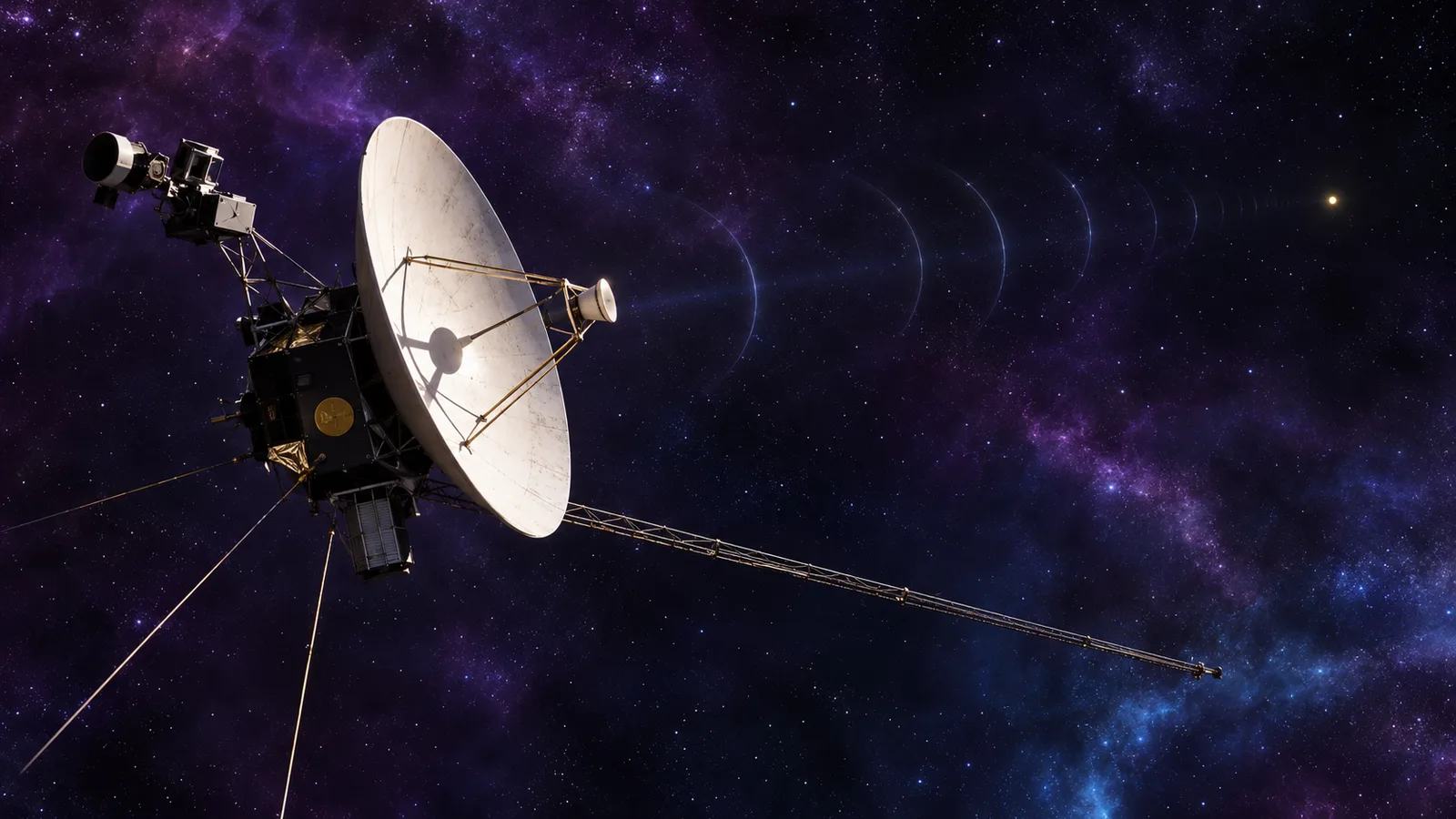
NASA briefly lost contact with Voyager 1 on October 18 and 19, 2026, when the Deep Space Network detected no signal during two scheduled attempts. The signal returned October 20. Engineers are still investigating the cause but found a thruster group had gone offline and backups switched on.
NASA's Deep Space Network could not detect a signal from Voyager 1 on October 18, and on the next scheduled attempt on October 19 there was still no signal. The two scheduled communication attempts were 24 hours apart, and the signal reappeared on October 20. The signal returned before the team sent commands from Earth to troubleshoot the issue. At the time of the interruption, the spacecraft was approximately 16 billion miles from Earth.
What engineers have found so far
Engineers still do not know what caused the communication problem and are continuing to investigate. They found that one group of Voyager 1's thrusters had gone offline, and onboard computers automatically switched to a backup set through fault protection. Diagnostic data obtained after communications were restored indicated the onboard computer had detected an anomaly with the original thrusters. This could indicate the computers detected a problem and put the spacecraft into a safe mode.
The power-saving "Big Bang" procedure
In early September, the Voyager team replaced three devices aboard Voyager 1 with alternatives that use less electricity, in an operation nicknamed the "Big Bang". The three devices that were switched off were warming devices. The procedure came about six weeks after engineers carried out an identical procedure on Voyager 2. It is expected to extend the lifetime of the twin spacecraft by a few more years. Without it, NASA could have had to shut down another Voyager 1 instrument as early as summer 2027.
The Voyager probes are powered by heat from decaying plutonium converted into electricity. Each spacecraft loses about 4 watts of power per year.
A milestone ahead
NASA expects Voyager 1 to reach a distance of about 16.09 billion miles from Earth on November 18, 2026, equal to one light-day. A light-day is the distance light travels through a vacuum in 24 hours. Once the probe passes that point, a radio message from Earth will take 24 hours to reach it, and its reply another 24 hours to return.
Voyager 1 was launched in September 1977 and travels at approximately 38,000 mph. It has traveled farther than any other human-made object. Voyager 1 and Voyager 2 are in interstellar space and are the only human spacecraft to have directly reached it. Voyager 1 also carries a 12-inch gold-plated copper phonograph record containing sounds, scientific data, music and greetings in multiple languages.